Akedah Knife
The Lost SymbolThe Akedah Knife is an ancient blade whose legendary history gives it a central role in Mal’akh’s attempt to turn a symbolic rite into a human sacrifice. Made, according to the account Peter Solomon recognizes, from meteoritic iron and associated with Abraham’s near-sacrifice of Isaac, it is both a historical artifact and the instrument around which Mal’akh constructs his final ritual. At the climax, Peter holds the knife but refuses to kill Mal’akh; the blade is ultimately broken, and the sacrifice Mal’akh has planned does not occur as he intends.
Identity and Claimed History
Mal’akh identifies the knife as an artifact more than three thousand years old, forged from iron that fell from the sky. The account links it to the biblical story of the Akedah: Abraham’s near-sacrifice of his son Isaac on Mount Moriah, as recounted in Genesis. Peter recognizes the object and knows its legend, although his recognition does not mean he accepts Mal’akh’s claim that the legend grants the knife a power that should be activated through sacrifice.
The blade’s reported history passes through strikingly different custodians: popes, Nazi mystics, European alchemists, and private collectors. In Mal’akh’s interpretation, each possessed or admired it without fulfilling its intended purpose. That history makes the knife more than a rare possession in his eyes. He regards its long passage through human hands as a delay before the act he believes will reveal its true power. The evidence establishes this as Mal’akh’s conviction, not as an independently verified supernatural property of the artifact.
Its religious association also gives it a place in Masonic ritual. Mal’akh invokes the first degree of Freemasonry, in which Abraham’s willingness to offer Isaac is treated as an example of submission to a supreme being. He uses that familiar ritual meaning to argue that Masons acknowledge sacrifice while refusing to carry it through literally. The knife therefore becomes the point where a story already present in scripture and ritual is, in Mal’akh’s view, supposed to become physical action.
Mal’akh’s Plan for the Knife
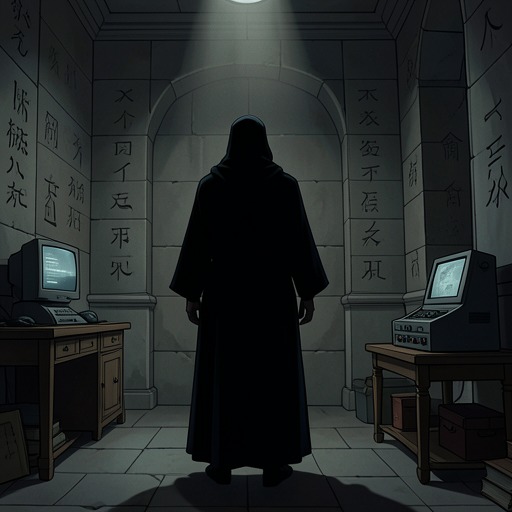
Mal’akh has spent a fortune locating and obtaining the blade. He brings it to the chamber at the top of the House of the Temple and places it within a prepared arrangement that includes a white cloth, an Egyptian-myrrh censer, Peter’s blood mixed with ash, and a crow’s feather. The knife is not an incidental weapon in this scene: Mal’akh assigns it a specific place in a rite meant to complete his transformation. He treats the artifact’s age, its association with Abraham, and its meteoritic origin as parts of a single sacred authorization.
Before the planned sacrifice, Mal’akh uses the knife to cut the ropes binding Peter to his wheelchair. This practical act gives the object an immediate role in the confrontation, but it also frees Peter only to be placed under a more deliberate pressure. Mal’akh then puts the knife in Peter’s left hand and makes Peter’s action the intended means of his own death. The gesture turns the artifact into an instrument of coercion: Mal’akh wants Peter, not himself, to carry out the decisive act, while insisting that the act will complete a sacred offering.
Mal’akh’s argument rests on his own doctrine that spiritual transformation requires the offering of what is most precious. He presents himself as the offering and claims that Peter’s participation will release him from his body. Peter, meanwhile, is being pressured through threats to Katherine and through the losses Mal’akh has inflicted on his family. The knife’s ritual meaning thus serves Mal’akh’s scheme as well as his religious language: it makes his demand appear to belong to an ancient order, even as Peter is being forced to choose under immediate personal threat.
Peter’s Refusal and the Climax
As the confrontation reaches its crisis, Peter rises from his wheelchair and stands over Mal’akh, who has arranged himself on the altar. Peter holds the knife, but his hesitation is not evidence that he accepts Mal’akh’s interpretation. The scene foregrounds the conflict between Mal’akh’s insistence on a predetermined sacrificial role and Peter’s still-unresolved choice. Mal’akh tries to make Peter’s grief and anger serve the rite; Peter’s decision instead remains his own.
Robert Langdon and Agent Simkins reach the Temple Room as Peter is about to act. Langdon enters and tackles Peter, interrupting the moment at the altar. In the ensuing commotion, a helicopter’s contact with the skylight causes it to break, and falling glass fills the chamber. The Akedah Knife is found broken beside Mal’akh, smashed against the granite altar. Peter has not used it to spill Mal’akh’s blood. The artifact that Mal’akh treated as the indispensable instrument of his transformation is rendered unusable during the intervention that prevents the intended killing.
Significance of the Broken Blade
The knife’s change from revered relic to broken object gives the climax its material force. For much of the scene, Mal’akh’s account of the blade’s past appears to make violence seem like the completion of an old sacred pattern. Yet the artifact does not determine what Peter will do. Peter can hold it without accepting Mal’akh’s purpose, and his refusal breaks the link Mal’akh tries to establish between inherited ritual and inevitable action.
The knife also gathers the story’s competing meanings of sacrifice into one object. Mal’akh sees the blade as the means to make his body an offering and achieve the transformation he seeks; Peter encounters it as a demand that he kill his son. Its final break leaves neither interpretation fulfilled as Mal’akh planned. The object’s legend remains, but in the decisive scene its physical condition registers the collapse of the rite: the old story does not compel its repetition, and the knife cannot make Peter enact Mal’akh’s version of it.